BEP Review, 9/28/06

At today’s BEP Review Committee meeting in Nashville, James W. Guthrie, Director of the Peabody Center for Education Policy at Vanderbilt University, gave his presentation on an alternate method of determining fiscal capacity.

Last year, the Legislature charged the BEP Review Committee with the task of developing a “consensus recommendation” for moving to a system-level fiscal capacity formula.  Last year proved conclusively that there was not, and would never be, a consensus for the TACIR prototype system-level formula developed by Harry Green, since it caused a majority of Tennessee school systems to lose money while enriching the state’s four largest cities.

Guthrie’s proposal uses only property tax base (value of taxable property) and sales volume to calculate fiscal capacity; each is multiplied by a “computational” tax rate (in theory, something like the state average or mean, I guess) to determine a school district’s ability to pay.  There would be no sharing between Counties and municipal or special school districts therein, and the City or SSD residents would pay taxes only for the school district in which they live.  It’s clean, it’s understandable, and transparent.

In other words, no black magic box filled with hexes to twist and distort statistical data that at most three people in the state truly understand; there’s room for a lot of mischief in the nine-variable “least squares multiple linear regression model” that TACIR proposed, and last year’s BEP Review Committee set forth as one of its objectives that the formula should be straightforward, understandable, and explainable.

There are no numbers yet, but a draft should be prepared in advance of the next meeting on Oct. 11th.  Other factors such as at-risk students and English Language Learners can be incorporated into the BEP formula itself, although there may have to be some tweaking of Guthrie’s proposal to adjust for municipal systems that are only K-6 and such.

This one looks as though it could be fair and equitable.  The question is, can the state add enough money that funding for every child in every  district is adequate?  It must be.  The answer to our problem is not to simply rearrange who gets a bigger piece of the pie at someone else’s expense — there must be a minimum standard of adequacy.

We will all be better off to resolve this problem.

Watch this space…

I spent the better part of the day commuting to and from Nashville for the BEP Review Committee meeting, where their wireless network was only half working. Although I could gain access to the network, it wasn’t assigning DNS servers, so I couldn’t reach the internet.

There is a school board meeting tonight, but I’ll have a full report on the BEP Review by tomorrow. Actual numbers for the Vanderbilt version of fiscal capacity won’t be available until close to Oct. 11, but what they’ve proposed appears to be a definite improvement over the TACIR prototype. At least now, the committee agrees that there must be a consensus recommendation, which precludes any plan that takes funding from some systems to redistribute to others.

They’re ASS&S!

There is actually an organization with that name (though I don’t think they use the acronym): the Alliance for Separation of School & State.  The homepage of their website solicits support for their public proclamation:

“I proclaim publicly that I favor ending
government involvement in education.”

That sounds very much like “abolish all public schools.”

If you click on State Rankings at the top, it shows how many people from each state have signed on to their petition.  Then, if you click Tennessee, it shows you exactly who these 595 people are (with location and some with comments, ranging from their religious affiliation, profession, or number of children).

In yesterday’s Oak Ridge Observer (I’ll link it when goes online, but until then, get your own) Stan Mitchell did a straightforward interview with both candidates for State Representative in our district.  Both listed education as a priority — Jim Hackworth ranking it as his top priority.  David Massengill said he supports more local control, which sounds good.

Question is, just how local?  Local as in local school system?  It doesn’t appear to be so.  Go on down the Tennessee ASS&S list — it’s in alphabetical order — and guess whose name is on there?  David Massengill.  Of Clinton.  Candidate for State Rep.

Massengill has signed a statement that “I proclaim publicly that I favor ending
government involvement in education.” 

I fully support the right of parents to select the best and most appropriate education for their child or children — not just public schools, but also including home schooling (meeting the State’s modest qualifications and criteria), private, or parochial schools.

Despite that view, I steadfastly maintain that quality public schools are necessary to ensure our future.  Every child must have an opportunity to learn — if they do not, then our immediate future as a nation is in grave peril.

ASS&S indeed.

Education Forum Today

This afternoon’s education forum in Clinton brought a preview of the State’s likely course in the coming year: funding will be a key issue, but recently, the discussion has moved from “equity” to “adequacy.” That’s a giant step forward, because as long as they’re just rearranging who gets more and who gets less, we’re doomed to be “equally inadequate.”

Jerry Winters, Director of Government Relations for TEA (the state teachers’ union) predictably expressed concern about “virtual schools” (also called e-learning, where students could complete coursework online rather than in a traditional classroom) run by private, for-profit companies siphoning off per-pupil funding from the public schools. He’s also concerned about health issues, and stressed that we shouldn’t expect our teachers to also function as nurses.

He closed his opening remarks with a statement of opposition to “differentiated compensation” (higher rates of pay for harder to fill posiitons, such as advanced science and math teachers. Of course, since the TEA includes a large number of elementary teachers and those who teach something other than advanced science, math, or foreign languages, it’s not surprising that a majority would be opposed.

Bruce Opie, the Legislative Liason for the Department of Education, reiterated that funding would again be at the top of the priority list. He indicated that after reviewing performance data for pre-K programs in Tennessee and elsewhere, the Governor is now “a believer” in the effectiveness of that program, and that his goal is to have voluntary preschool universally available — beginning with at-risk and economically disadvantaged children.

The Governor has also been studying best practices at some of the State’s top performing high schools, and is looking toward improving the senior year experience by fostering partnerships between community colleges and the high schools in their service area. One example of a program that’s already underway is between Northeast State Technical Community College and high schools in the Tri-Cities area. There, students can pursue dual enrollment, earning both high school and college credit simultaneously.

All three school systems in Anderson County were represented either by board members, administrators, or both. Audience questions seemed, for a change, to be largely in sync — a need for some state funding for School Resource Officers and relief from unfunded mandates (such as the state’s allowable pupil-teacher ratio being imposed at the classroom level, while funding is only provided at the system level, resulting in a number of required teaching positions for which there is no state funding at all).

A shared concern among audience members was actually federal mandates, both No Child Left Behind, and the Individuals with Disabilities Education Act. An interesting discussion ensued about the theory of declining all federal funding and eschewing all federal mandates, and whether the dollars would balance. No conclusion was reached, but the $1 billion in federal funds that flows to the state for education seemed to be a sticking point that no one could move beyond.

Jim Hackworth closed by reminding the audience that Anderson County has seen over 5,000 new jobs created in the past five years, with a $600 million increase in the tax base. Education is critical to economic growth, and is one area with an almost certain return on the investment.

Invitation

This Friday, Sept. 22, you’re invited to a tailgate party before the ORHS v. Jefferson County (Homecoming) game, in honor of State Rep. Jim Hackworth, at the new home of Betsy and Gary Coleman.

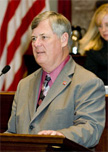
Jim HackworthJim is an outstanding supporter of public education, an outspoken advocate for our communities in the 33rd District, and an all-around really good guy. If he tells you he’ll follow up, he does. If you call, he listens. Beyond that, he doesn’t wait for people to ask for information — he brings the information to you, as is the case with the education forum this afternoon in Clinton featuring a couple of experts from the State.

A couple of years ago, he brought in several people to talk about fiscal capacity as it relates to education financing. He’s conducted a number of forums on health care.

There’s no set price of admission, but it would be nice if you could contribute something, even just what you would otherwise spend on dinner that evening (we’ll be serving Buddy’s BBQ and an assortment of homemade sides).

We’ll need an RSVP by Thursday — e-mail me, or call Betsy at 482-0021. You’ll get the address then, so we definitely know how many to feed.

Education Forum

Are you aware that the State Board of Education is considering additional graduation requirements, at a time when all high schools are struggling to increase graduation rates?

Do you wonder why some communities pay more than others to provide more than a “basic” education for public school students? Or, why the local matching requirement is different from one county to the next?

Do you think that our schools are doing enough, or not nearly enough, in terms of academics, safety, health and wellness, or anything else?

On Monday, there will be a public forum on education featuring Bruce Opie, Assistant Commissioner for Teaching and Learning for the State of Tennessee, along with Jerry Winters of the Tennessee Education Association. Bruce has the governor’s ear on education issues, and Jerry brings the viewpoint of the state’s teachers. It would be a great opportunity to learn more about what we’re doing — and what we need to do — to improve education and opportunity in Tennessee.

The forum begins at 4:30 p.m. on Monday, September 18, in the Little Theatre at Clinton High School. Everyone is welcome.

It’s also your chance to give input on what’s needed — or what’s not — to the folks who can carry your message back to Nashville.

This seminar was organized by Rep. Jim Hackworth, who has put forth an excellent effort over the last four years to bring information to this community so that we better understand the viewpoint from the capitol, and to offer us the opportunities of access and input to the decision making process. Thanks, Jim; we appreciate your service, and the fact that you really do work to bring us into the process.

Educational Improvement

This morning, the Nashville City Paper carried a story about a new initiative proposed by the governor: that every student scoring at least a 19 on the ACT could attend any of Tennessee’s community colleges at no cost.   The purpose is to motivate students to stay in school, raising the graduation rate.

I first heard this news last night from Gary Nixon, Executive Director of the State Board of Education, at the TSBA Fall District Meeting at Scott County High School.  However, Nixon brought along some more sobering statistics on the level of high school coursework and ACT performance required to secure “zone 3” employment — jobs that do not require a college degree, but that provide an income sufficient to sustain a family of four (about $39,000 per year).

According to Nixon, an analysis by the College Board determined that the threshold for success either as a college freshman, or as a candidate for “zone 3” employment, are the same: an ACT science score of 24, math score of 22, English score of 18, and at least a 21 in reading.  The College Board also provided a listing of high school coursework generally required to achieve those scores, which for math and science, exceed State requirements: biology, chemistry and physics for the science portion, along with Algebra I, Geometry, Algebra II and Trig.

It’s not just the number of hours that makes the difference, but the actual courses taken.  Physics is the big predictor in the science score, he said, because it has a strong tie to math and logic, boosting both scores.  Most kids don’t take physics in high school; many never take trig — the requirement is simply three years of math, and passing the Algebra I gateway exam (which most Oak Ridge students easily pass in the 8th grade).

The State Board of Ed is seriously considering requiring math all four years, so that students don’t slack off in their senior year.  They’ve also debated adding reading classes to every year of school, K-12.

The Legislature continually talks about adding more mandatory PE classes, “personal finance” curriculum, and other wellness-type coursework.

School board members are wondering where we’re going to fit in all these new requirements — will school go until 5 p.m.?  Will they drop some other requirements?  Will our students be able to take any elective courses at all?

Board members in areas not blessed with the wealth of math and science talent that Oak Ridge has are asking, “where will we find all these new math and science teachers, since they have to have a degree in their subject area (in addition to teaching certification)?

Statewide, of every 100 9th graders, 35 will pursue postsecondary education.  Half of those will require developmental (remedial) courses in college.  About 16 will graduate in 150% of the expected time (3 years for an AA or AS, 6 years for a BS or BA).  The numbers are dismal; if we are to improve our economic standing and quality of life, we must find a way to raise the bar.

Is it possible to require more rigorous courses and raise the graduation rate at the same time?  I think it is, but it will require change going back to the middle grades, 5-8, to ensure that high school students are adequately prepared for more rigorous courses.  And, that change may well have some impact on AYP, or “adequate yearly progress,” as defined by No Child Left Behind.

While opportunity for all is a wonderful concept (as is “no child left behind”), we’re faced with evidence that a 19 on the ACT is neither sufficient preparation for college, nor for a job that produces a decent living wage.  While I applaud Governor Bredesen for his ambitious goal of sending everyone to college, I believe that we must first ensure that they’re adequately prepared — whether for work or higher education.

That will mean increasing funding for K-12 first.  It can be done.

BEP Review Meeting Today

The BEP Review Committee is a group established by the Legislature to annually review the state’s education funding mechanism — the BEP.  Membership consists of the Chairs of the House and Senate Education Committees, representatives of the State Board of Education, the Comptroller’s office, Tennessee School Boards Association, Tennessee Organization of School Superintendents, a representative of the “small schools” coalition, along with superintendents and finance directors of various school systems.

At the end of the Legislative session, the General Assembly directed the BEP Review Committee to develop a “consensus recommendation” on moving to a system-level fiscal capacity model — one that would evaluate ability to pay based on the school district’s, rather than the whole county’s economic data.

The largest part of today’s meeting was devoted to a presentation by Leonard Bradley, a Vanderbilt professor and a member of the Peabody Center for Education Policy.  The Peabody Center became involved at the invitation of the State Board of Education, following considerable dissent last year over the proposed system-level formula developed by TACIR.  One of the agreed-upon goals of the BEP Review Committee is that the formula should be as simple as possible, defensible, and easy to explain; Bradley stated that they recognized the most immediate problem was to examine issues lurking within the current BEP.

The haste, of course, is that the BEP Review Committee was clearly directed by the Legislature to develop a consensus recommendation for change by Nov. 1, the date of the committee’s annual report.  One of the things I found disturbing is that several months have elapsed without further study or attempt at consensus, with a recommendation due in two months.  Bradley was not optimistic about being able to even gather the necessary data by that time, although he did acknowledge that they had ascertained that the necessary data does exist within state government.

That data is primarily comprised of property valuation by school system, although sales tax data may also be available.  The short term goal seemed to be simply using property values and sales volumes to establish a district’s ability to pay, and assigning state funding commensurate with that ability.
Richard Kitzmiller of Kingsport pointed out that if this sytem is used, it would be necessary to change state law regarding shared taxes (all county residents pay some portion of their property taxes dedicated to education operations, including city residents, all of whom pay county taxes, but only a portion of which is returned to their city school system).  If the County were no longer required to share, City residents would not have to pay the portion of County taxes dedicated to education.  The City could then raise property taxes by the amount needed to make up the difference — likely, a smaller tax rate than what was removed by the County, as property values in the Cities tend to be higher.

The same would be true for not sharing sales taxes — therefore, Oak Ridge would get back the half-cent superseded by the County in May.

Nothing was decided at today’s meeting, except that three more meetings will be needed before the Nov. 1 deadline.  At present, they are scheduled to be on Sept. 28, Oct. 11, and Oct. 23.  At the first of those, the Peabody Center should have a basic idea of what the new way to determine fiscal capacity should be.

I confess that they seemed to me to be speaking in code, but at the break, Dr. Kitzmiller (the Kingsport superintendent, who is a member of the committee and an advocate for municipal school systems) told me that it’s his opinion that this would be a positive change.  We would certainly receive less State funding, since all the cities are more affluent than their respective counties, but without having the “shared” taxes, we would have more revenue available for the same or less burden upon the taxpayer.

A reporter from Metro Pulse was there, but few other local school board members besides Dan DiGregorio and myself.  Oak Ridge lobbyist Bill Nolan was also present, and I don’t think it escaped the committee’s notice that Oak Ridge is both interested and watching.  But, with the real work ahead, it looks like I’m going to be headed back with some frequency this Fall.

TACIR on Taxes

Both Anotherthing2 and Cup of Joe Powell have noted the recent TACIR study: Local Government Property Tax Revisited: Good News and Bad News. In short, the analysis by Harry Green and Stan Chervin finds that

the growing property tax burden and growing local government dependence on the property tax are on a collision course.

While they note that the problem stems from the fact that property tax revenues, while fairly elastic, is not growing at the same rate as demand for services, no mention is made of exactly which local government services might be driving the pressure on local government budgets.

I would surmise that for all counties, along with the cities and special school districts that support school systems, one of the largest drivers is education costs.

Green and Chervin close with three proposed actions:

1. An expanded state circuit-breaker program designed to blunt the impact of rising property tax burdens on a broad-spectrum of low and moderate income households. The state aid should be targeted to phase out as family income rises, but not set so low that moderate income families are excluded from the program.

2. A significant increase in state aid to local governments designed to help them provide a basic level of services to their residents. The aid should go to the level of government that supplies the service (need based), and reflect consideration of both fiscal capacity and fiscal effort.

3. Significant new taxing authority that allows local governments to take advantage of existing tax bases or activities that are currently untaxed. Possible changes include an increase in the local sales tax single article limitation (currently set at $1,600), the authority to levy payroll taxes, and local ad valorem vehicle taxes in lieu of existing wheel taxes.

So, while admitting that the problem stems from the cost of services not keeping pace with property tax revenues, their first suggestion is to put some sort of limit on property tax increases. How, then, will local governments pay for these services? And of course, no mention is made of the fact that low to moderate income residents already pay low to moderate property taxes, simply because the amount is determined by the value of their property. One exception would be for the elderly, who may well have a more expensive (paid for) residence, while on a fixed retirement income.

That the State needs to step up to the plate with a significant increase in aid to local governments is a no-brainer, but I take issue with tying such aid to “fiscal capacity,” as the fiscal capacity formula is flawed in that it does not take into account property tax rates relative to others — a local government with a high property tax rate is deemed “more wealthy,” while those with lower property tax rates are categorized as “more needy.”

I’m certain that the prospect of allowing new taxing authority to local governments is bound to cause significant outcry, but it’s worthy of consideration. Take, for example, the concept of a payroll tax: communities with a large employment base, where many work in, but do not live (or pay taxes) in that community are an expense — traffic management, streets, utilities, and emergency services. Currently, the expenses for the non-resident workforce falls heavily on the residents, especially in a city like Oak Ridge, where the employer pays no property tax.

If some of the expense for those commuter costs were relieved via a payroll tax, then more of the resident property tax receipts would be available for resident services (like education).

I agree completely that something has to change, and that the local property tax is being squeezed. The State and Federal governments must commit to fully funding their mandates — or simply making optional recommendations.

I’ve taken Harry Green to task before, with no success in changing his perspective… but I have had some measure of success in pointing out the flawed reasoning to others. Like the Senate Education Committee. Harry and I have written dueling editorials for Tennessee Town and City. Unfortunately, rather than intelligent public discourse, this argument seems to have gotten personal.

Heaven forbid that anyone should challenge the great and mighty statistician on the formula that he personally developed… one so complex that few in government understand, but simply take at face value.

It’s simple: a community with a high tax rate to support essential services must be given credit for that effort, or else the incentive is to not support those essential services. And the only way to properly measure that effort is to compare tax rates, particularly measuring the allocations to services required by the State.

If Tennessee would only commit to a realistic level of per-pupil spending in education, an equal amount for every pupil in the state, then a huge burden would be lifted from the local property tax.

Update: Case Closed…

An article in this morning’s Chattanooga Times-Free Press (or PDF here) quotes Jesse Register, Superintendent of Hamilton County Schools, as saying:

“I think it’s good the case has been dismissed, because that means it’s been settled,” Dr. Register said. “I’m hopeful now with the small systems lawsuit out of the way that other inequities in the funding formula that don’t treat the urban systems well will be addressed, too.”

The TFP article does not directly quote the Chancellor, whose remarks in the AP story indicate that any major changes would be considered grounds for reopening the suit, and (attorney for the plaintiffs) Donelson’s argument against the dismissal specifically referenced the urban systems’ push for change.

Further down, it’s clear that Hamilton County Commissioners didn’t make that connection either:

Hamilton County Commission Chairman Larry Henry said he and several other members of the commission are prepared to enter a lawsuit to change the BEP formula, if need be.

“We’re nowhere near where we ought to be (in terms of funding), and that puts an unnecessary burden on the citizens of Hamilton County,” he said. “That would be a last resort, but if it’s what we have to do, it’s what we have to do.”

Seems we’ll have to wait a bit before drawing conclusions about whether it’s over or not.