Invitation

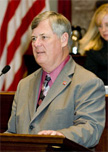
This Friday, Sept. 22, you’re invited to a tailgate party before the ORHS v. Jefferson County (Homecoming) game, in honor of State Rep. Jim Hackworth, at the new home of Betsy and Gary Coleman.

Jim HackworthJim is an outstanding supporter of public education, an outspoken advocate for our communities in the 33rd District, and an all-around really good guy. If he tells you he’ll follow up, he does. If you call, he listens. Beyond that, he doesn’t wait for people to ask for information — he brings the information to you, as is the case with the education forum this afternoon in Clinton featuring a couple of experts from the State.

A couple of years ago, he brought in several people to talk about fiscal capacity as it relates to education financing. He’s conducted a number of forums on health care.

There’s no set price of admission, but it would be nice if you could contribute something, even just what you would otherwise spend on dinner that evening (we’ll be serving Buddy’s BBQ and an assortment of homemade sides).

We’ll need an RSVP by Thursday — e-mail me, or call Betsy at 482-0021. You’ll get the address then, so we definitely know how many to feed.

Test Prep

The following letter from the test prep company probably failed from a marketing standpoint.

Exerpts included (courtesy of the Star-Telegram in Texas):

“Many students believe that if they do not know the answer to a question they should leave it blank rather than loose 1/4 point if they get it wrong…”

“What are the difference between the SAT & the ACT?”

“Students discover that relying on calculators can cause errors, and that the single biggest strategy they can use to improve their math score.”

“Colleges don’t care how many times you take they test, they are only interested in your highest score.”

There is room in this world for people of talents beyond the written or spoken word, but make no mistake: language matters. UT Engineering Professor Spivey Douglass now warns his classes that papers will be graded for grammar as well as content. Communication is essential to success in most fields of study and professions.

The answer is not one of which test preparation program to use (although there are several that are quite good), but for students to take challenging courses throughout high school and focus on mastery of math and English. Without question, other subjects are important — but the ability to read, write, and reason is the essential foundation for so many other pursuits.

As the Fall testing season arrives for high school Juniors and Seniors, remember: check first with the websites of the test providers for practice materials, and if a study guide is needed, seek the recommendation of a guidance counselor or department head.

Education Forum

Are you aware that the State Board of Education is considering additional graduation requirements, at a time when all high schools are struggling to increase graduation rates?

Do you wonder why some communities pay more than others to provide more than a “basic” education for public school students? Or, why the local matching requirement is different from one county to the next?

Do you think that our schools are doing enough, or not nearly enough, in terms of academics, safety, health and wellness, or anything else?

On Monday, there will be a public forum on education featuring Bruce Opie, Assistant Commissioner for Teaching and Learning for the State of Tennessee, along with Jerry Winters of the Tennessee Education Association. Bruce has the governor’s ear on education issues, and Jerry brings the viewpoint of the state’s teachers. It would be a great opportunity to learn more about what we’re doing — and what we need to do — to improve education and opportunity in Tennessee.

The forum begins at 4:30 p.m. on Monday, September 18, in the Little Theatre at Clinton High School. Everyone is welcome.

It’s also your chance to give input on what’s needed — or what’s not — to the folks who can carry your message back to Nashville.

This seminar was organized by Rep. Jim Hackworth, who has put forth an excellent effort over the last four years to bring information to this community so that we better understand the viewpoint from the capitol, and to offer us the opportunities of access and input to the decision making process. Thanks, Jim; we appreciate your service, and the fact that you really do work to bring us into the process.

Educational Improvement

This morning, the Nashville City Paper carried a story about a new initiative proposed by the governor: that every student scoring at least a 19 on the ACT could attend any of Tennessee’s community colleges at no cost.   The purpose is to motivate students to stay in school, raising the graduation rate.

I first heard this news last night from Gary Nixon, Executive Director of the State Board of Education, at the TSBA Fall District Meeting at Scott County High School.  However, Nixon brought along some more sobering statistics on the level of high school coursework and ACT performance required to secure “zone 3” employment — jobs that do not require a college degree, but that provide an income sufficient to sustain a family of four (about $39,000 per year).

According to Nixon, an analysis by the College Board determined that the threshold for success either as a college freshman, or as a candidate for “zone 3” employment, are the same: an ACT science score of 24, math score of 22, English score of 18, and at least a 21 in reading.  The College Board also provided a listing of high school coursework generally required to achieve those scores, which for math and science, exceed State requirements: biology, chemistry and physics for the science portion, along with Algebra I, Geometry, Algebra II and Trig.

It’s not just the number of hours that makes the difference, but the actual courses taken.  Physics is the big predictor in the science score, he said, because it has a strong tie to math and logic, boosting both scores.  Most kids don’t take physics in high school; many never take trig — the requirement is simply three years of math, and passing the Algebra I gateway exam (which most Oak Ridge students easily pass in the 8th grade).

The State Board of Ed is seriously considering requiring math all four years, so that students don’t slack off in their senior year.  They’ve also debated adding reading classes to every year of school, K-12.

The Legislature continually talks about adding more mandatory PE classes, “personal finance” curriculum, and other wellness-type coursework.

School board members are wondering where we’re going to fit in all these new requirements — will school go until 5 p.m.?  Will they drop some other requirements?  Will our students be able to take any elective courses at all?

Board members in areas not blessed with the wealth of math and science talent that Oak Ridge has are asking, “where will we find all these new math and science teachers, since they have to have a degree in their subject area (in addition to teaching certification)?

Statewide, of every 100 9th graders, 35 will pursue postsecondary education.  Half of those will require developmental (remedial) courses in college.  About 16 will graduate in 150% of the expected time (3 years for an AA or AS, 6 years for a BS or BA).  The numbers are dismal; if we are to improve our economic standing and quality of life, we must find a way to raise the bar.

Is it possible to require more rigorous courses and raise the graduation rate at the same time?  I think it is, but it will require change going back to the middle grades, 5-8, to ensure that high school students are adequately prepared for more rigorous courses.  And, that change may well have some impact on AYP, or “adequate yearly progress,” as defined by No Child Left Behind.

While opportunity for all is a wonderful concept (as is “no child left behind”), we’re faced with evidence that a 19 on the ACT is neither sufficient preparation for college, nor for a job that produces a decent living wage.  While I applaud Governor Bredesen for his ambitious goal of sending everyone to college, I believe that we must first ensure that they’re adequately prepared — whether for work or higher education.

That will mean increasing funding for K-12 first.  It can be done.

Observer Today!

Want to see a 98-yard touchdown, slam-dunk, knock-it-out-of-the-park home run all at once? Go right now and get a copy of the Oak Ridge Observer (if you lacked the foresight to subscribe and have it delivered, that is). It’s free — no excuses!

Turn to page 10 and read the guest column, “Oak Ridge Schools deserve stronger funding,” by Jacob Kilpatrick. Then read it again.

If Mr. Kilpatrick should read this, thank you. People like you make me really happy to call Oak Ridge home.

Live Wire

At the City Council meeting on Sept. 25, one of the items for consideration is a 2.5% reduction in electric rates — following a 4.5% drop in the wholesale rate charged to the City by TVA.

Overall, TVA raised rates 17.45% last year. At the Council meeting where local rates were raised, I remember there being explicit clarification that the increase was a direct pass-through of the wholesale increase. Why then, not a direct pass-through of the wholesale decrease? The explanation provided by Janice McGinnis in yesterday’s Oak Ridger was this:

Oak Ridge’s proposed rate reductions are smaller than the approved TVA reductions because wholesale power costs do not account for all retail power costs, McGinnis said.

Also, Oak Ridge officials want to keep about 1 percent of the rate reduction to cover their costs, she said.

I’d be reallly interested in a more detailed explanation of the city’s costs, and what they plan to do with the extra 1% they’ll use “to cover their costs.” Shouldn’t that be 2%, since that’s the difference between TVA’s lower rate and the proposed decrease for Oak Ridgers?

She also alluded to a difference in the actual rate reduction for residential and commercial users, which makes me wonder how the school system is classified (being neither residential nor commerical), and how much of a decrease we might see. To be certain, any decrease in costs is most welcome in this tight budget year, but the schools have seen the short end of the stick before. And, the huge jump in energy prices was one of the big hairy monsters in this year’s budget… one we’d like to get away from now with Payless Power.

I realize that watching City Council meetings is almost as boring as watching School Board meetings, but it’s your money. It might pay to pay attention to this one.

FOOTNOTE: Oak Ridge Schools has budgeted $1,081,763 for electricity usage this year.  A 2.5% decrease would yield a savings of about $27,044 — about a quarter-mil short of replacing the lost bus service (just in case you were wondering).

Keys to the SAT

The number of students hitting the coveted perfect score on the SAT has plummeted (1,000 last year; 238 this year) after the addition of an essay to the college entrance exam, according to the New York Times.

It’s no secret that student writing has declined, although I’m not sure anyone has pinpointed any one major cause. But for students preparing for this test, below are three keys to a better score:

  • Longer essays (two pages is the limit) tend to receive higher scores;
  • Penmanship counts: essays written in cursive received slightly higher scores;
  • Write in third-person: the lowest performing students almost always write in first person, and first person essays score lower.

Speculating on the cause of less-developed writing abilities leads one to wonder about the changes in curriculum: has the material covered in K-12 indeed been added to so often, that it is now “a mile wide and an inch deep?”

Lastly, the essay is only about one-fourth of the writing score; performing well on the 49 grammar and usage questions is critical. For any student preparing for this test, the Harbrace College Handbook is still considered the ultimate authority on mastering the written word.

Xenophobia on the Rise

Whether a recent thread on the Oak Ridger’s message forum, or an article last week in the Rocky Mountain News, it appears that many in this country have come down with a serious, irrational fear of people they perceive to be “foreigners.”

From the forum, I had the distinct feeling that some Oak Ridgers think that anyone who speaks with a Spanish accent, or works in a Mexican/Chinese restaurant, is an illegal immigrant. Jacket, SingingAtom, and ORHS73 represented the voices of reason: the reality is that, at least in this area, we have no reason to believe that “most” foreign-born people are illegals. Actually, we have every reason to believe that “most” are not, and those who do not have the proper documentation are very likely working and putting money into our local economy.

The situation in Colorado is even more distressing:

A seventh-grade geography teacher at Carmody Middle School in Lakewood was suspended with pay Wednesday after he refused to take down foreign flags displayed in his classroom.

A geography teacher isn’t allowed to display flags of countries his or her students are studying?? I think we were tested on it. Our own National Laboratory — a US Government facility — has a huge wall displaying the flags of scores of countries represented in their employee and user population.

Someone needs to do a little thinking about what has happened in the past, following the rise of nationalism in various countries: think Germany, Japan, etc…

No, I’m not comparing Bush to Hitler. I don’t think this one is his fault; I think it’s our own, and each of us who doesn’t stand up to it is guilty of allowing our country to head down a very risky path with a predictable outcome.

BEP Review Meeting Today

The BEP Review Committee is a group established by the Legislature to annually review the state’s education funding mechanism — the BEP.  Membership consists of the Chairs of the House and Senate Education Committees, representatives of the State Board of Education, the Comptroller’s office, Tennessee School Boards Association, Tennessee Organization of School Superintendents, a representative of the “small schools” coalition, along with superintendents and finance directors of various school systems.

At the end of the Legislative session, the General Assembly directed the BEP Review Committee to develop a “consensus recommendation” on moving to a system-level fiscal capacity model — one that would evaluate ability to pay based on the school district’s, rather than the whole county’s economic data.

The largest part of today’s meeting was devoted to a presentation by Leonard Bradley, a Vanderbilt professor and a member of the Peabody Center for Education Policy.  The Peabody Center became involved at the invitation of the State Board of Education, following considerable dissent last year over the proposed system-level formula developed by TACIR.  One of the agreed-upon goals of the BEP Review Committee is that the formula should be as simple as possible, defensible, and easy to explain; Bradley stated that they recognized the most immediate problem was to examine issues lurking within the current BEP.

The haste, of course, is that the BEP Review Committee was clearly directed by the Legislature to develop a consensus recommendation for change by Nov. 1, the date of the committee’s annual report.  One of the things I found disturbing is that several months have elapsed without further study or attempt at consensus, with a recommendation due in two months.  Bradley was not optimistic about being able to even gather the necessary data by that time, although he did acknowledge that they had ascertained that the necessary data does exist within state government.

That data is primarily comprised of property valuation by school system, although sales tax data may also be available.  The short term goal seemed to be simply using property values and sales volumes to establish a district’s ability to pay, and assigning state funding commensurate with that ability.
Richard Kitzmiller of Kingsport pointed out that if this sytem is used, it would be necessary to change state law regarding shared taxes (all county residents pay some portion of their property taxes dedicated to education operations, including city residents, all of whom pay county taxes, but only a portion of which is returned to their city school system).  If the County were no longer required to share, City residents would not have to pay the portion of County taxes dedicated to education.  The City could then raise property taxes by the amount needed to make up the difference — likely, a smaller tax rate than what was removed by the County, as property values in the Cities tend to be higher.

The same would be true for not sharing sales taxes — therefore, Oak Ridge would get back the half-cent superseded by the County in May.

Nothing was decided at today’s meeting, except that three more meetings will be needed before the Nov. 1 deadline.  At present, they are scheduled to be on Sept. 28, Oct. 11, and Oct. 23.  At the first of those, the Peabody Center should have a basic idea of what the new way to determine fiscal capacity should be.

I confess that they seemed to me to be speaking in code, but at the break, Dr. Kitzmiller (the Kingsport superintendent, who is a member of the committee and an advocate for municipal school systems) told me that it’s his opinion that this would be a positive change.  We would certainly receive less State funding, since all the cities are more affluent than their respective counties, but without having the “shared” taxes, we would have more revenue available for the same or less burden upon the taxpayer.

A reporter from Metro Pulse was there, but few other local school board members besides Dan DiGregorio and myself.  Oak Ridge lobbyist Bill Nolan was also present, and I don’t think it escaped the committee’s notice that Oak Ridge is both interested and watching.  But, with the real work ahead, it looks like I’m going to be headed back with some frequency this Fall.

Financial Report

Included in the materials for last night’s school board meeting was the usual month-end financial statement for the school system, except this was was for the month ending June 30, which is also the end of the fiscal year.

Budgeting is partly an art form; there are always unknowns, such as our approval last night for adding a half-time teacher assistant at the high school to serve one student. Federal funding for such extraordinary IDEA expenses is based on the student count at the end of last year, but this student just moved in. So, we bear the extra cost for the rest of the year, in spite of the fact that it’s a federally-mandated expense. We also added a kindergarten teacher at Woodland, due to the arrival of 23 more students than we expected.
Feel free to download the financial report and study it. The first half of the first page is the school system’s revenues; you can see what we budgeted to receive, what we actually received, the percentage of the budgeted amount, and the variance from the budgeted amount. Under revenues, it’s better to see numbers not in parenthesis… the parenthesis means we got that much less than expected.

Pay attention to percentages that are far above or below 100%. For example, line item 47143 — revenue for the Individuals with Disabilities Education Act (IDEA) closed out the year at 56.2%. Not only is the federal government not paying it’s fair share, but we only received a little more than half of what was expected — the unfair share.

The bottom half of the first page is expenditures. Here, it’s much better to see a number in parenthesis at the end… that means we spent less than we budgeted. All in all, we received $394,649 more than anticipated (0.95%), and spent $857,242 less than budgeted (2.1%), so we ended with a small amount that goes into the fund balance.

We’ll need it; we always do, because our budget is inadequate to really put the money into maintenance and repair that we ought to, so when something breaks, the fund balance is where it comes from.

As these are public records, feel free to download or print to your heart’s content.